


Variable Speed Control 2.5 Amps 120V (up to 2 ceiling fans) CN5041


Thermospeed Variable Speed Controller 120V 3 Amps ILG8SFST

VES Variable Speed Forward & Reverse Switch 120V 5 Amps (up to 3 ceiling fans) 103421


J&D Variable Speed Control 120V 5 Amps (Up to 4 Ceiling Fans) CN5

Variable Speed Forward & Reverse Switch 120V 5 Amps (up to 4 ceiling Fans) CNFRMC5

Variable Speed Control 15 Amps 120V (up to 12 ceiling fans) MC15


J&D Speed Control up to 12 Ceiling Fans 120V 15.0 Amps CN15

Weather Proof Digital Temperature Switch with Sensor Single Stage (Heating & Cooling) JDTDG01

Weather Proof Digital Temperature Switch with Sensor Two Stage (Heating & Cooling) JDTDG02

J&D Universal Manual Control w/ Cord, Switch & Dial 1 Stage 115 Volt JDAV010M-C
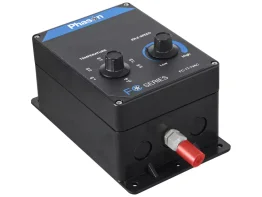
Modulating Temperature Control Moisture Resistant 7 Full Load Amps Phason FC-1T-1VAC


Varifan Variable Speed Control w/ Temp Probe up to 10 Amps VFSA-10C/S

J&D VFD Compatible Control w/ 10' Temp Probe 100V-240V JDAV12T2


How to Choose the Right Fan Control
Match the control to your motor type. This is the most important step. Most single-speed AC fan motors (PSC or shaded-pole types) can safely use a simple variable-speed dial or switch, which works by adjusting voltage to the motor. Motors with a "variable speed" listing are built for this. Motors that are not labeled variable speed often use a different starting mechanism internally and can be damaged by a voltage-based control.
Check your fan's specifications, or ask our team, before ordering a control for an existing fan. Beyond compatibility, the right choice comes down to which features matter most for your space: smooth variable adjustment, automatic temperature response, multi-fan coordination, or simple manual switching.
- Variable speed controls (dial or slide): Smoothly adjust airflow across a range rather than fixed steps, with immediate response as you turn the dial. The most common choice for PSC-motor exhaust and ceiling fans.
- Manual multi-speed switches: Step between a set number of fixed speeds (e.g., 2-speed) rather than a continuous range. Simpler and often more durable for basic applications.
- Forward & reverse switches: Reverse fan direction in addition to controlling speed, useful for seasonal airflow changes (e.g., circulating warm air down in winter, cooling in summer).
- Combination fan & light switches: Some controls manage both fan speed and lighting from a single wall plate — useful anywhere a ceiling fan and light fixture share a switch location.
- Temperature/thermostat controls: Automatically trigger actions like turning the fan on, off, or ramping through speed stages based on sensed temperature, useful for unattended spaces like attics, equipment rooms, or agricultural buildings. Weatherproof models are available for outdoor or exposed installations.
- Multi-stage ventilation controls (8-stage, 16-stage): Coordinate multiple fans or fan banks together for larger facilities, common in agricultural and large commercial ventilation systems where zones need to ramp up together.
Check the amp rating. Controls are rated for a maximum amperage and, for ceiling fan controls, a maximum number of fans (for example, up to 4 or up to 12 fans on a single control). Add up the full-load amps of everything you're connecting and choose a control rated above that total. Undersizing a control is a common cause of premature failure.
Indoor or outdoor? Standard controls are built for dry, indoor locations. If the control will be exposed to moisture or weather (outbuildings, agricultural settings, rooftop equipment), choose a weatherproof-rated model.
Best-selling controls tend to be the straightforward variable-speed dials sized for a handful of ceiling fans. A good starting point if you're not sure where to begin.
Still unsure which control fits your fan? Our Fan Finder tool can help confirm the right match, or contact our team with your fan's model number.
Why Choose Industrial Fans Direct for Fan Controls?
For more than 20 years, Industrial Fans Direct has provided ventilation and heating resources to customers across the U.S. and around the globe. We specialize in working with mechanical contractors, engineers, electricians, facility managers, and commercial building owners. Matching the right control to the right motor is exactly the kind of detail our team helps get right before you order, not after.
- Non-commissioned, knowledgeable team - we'll tell you honestly whether a control is compatible with your fan, not just sell you one.
- Factory-authorized, brand-new inventory - every control is backed by full manufacturer warranties.
- Strong manufacturer relationships - built over 20+ years to keep pricing competitive and the order-to-delivery process smooth.
- Free shipping on most orders, plus our Low Price Guarantee.
- Full feature breakdowns on every listing - amp rating, fan count, motor compatibility, and other key features are spelled out so you know exactly what you're getting.
Need Help Choosing?
- Not sure which control fits your fan? Try our Fan Finder tool.
- Sizing a new fan and control together? Use our CFM calculator chart.
- Have questions about compatibility or an order? Contact our team.
Frequently Asked Questions
Can I add a variable speed control to any fan?
No. The motor has to be designed for it, look for "variable speed" in the fan's title or specifications. Using a voltage-based control on an incompatible motor can damage the motor, the control, or both.
What's the difference between a variable speed control and a multi-speed switch?
A variable speed control adjusts airflow smoothly across a range. A multi-speed switch steps between a fixed number of set speeds. Both work only with compatible motor types, check your fan's specs either way.
How do I know what amp rating I need?
Add up the full-load amps of every fan (or the total number of fans, for controls rated by fan count) you're connecting to the control, then choose a control rated at or above that total. Undersizing can cause the control to fail prematurely.
What does a temperature/thermostat control do?
It automatically turns the fan on, off, or adjusts speed based on sensed temperature, useful for spaces like attics or equipment rooms where you don't want to manually manage the fan. Weatherproof versions are available for outdoor or exposed locations.
What's a multi-stage ventilation control used for?
These coordinate multiple fans together in stages, commonly in agricultural buildings or large commercial spaces where several fans or fan banks need to ramp up together as demand increases.
My fan isn't labeled "variable speed" - can I still control its speed?
Possibly, but not with a standard voltage-based control. Some motors require a different control approach (like a VFD paired with a three-phase motor) or aren't safely speed-controllable at all. Contact our team with your fan's model number and we'll help you find the right solution, or tell you honestly if one isn't available.
Can one switch control both my fan and a light?
Yes, combination fan and light switches are available for locations where both need to be managed from a single wall plate. Standard accessories like matching wall plates are also available in a range of finishes and colors.